Reconfiguring Care for Sustainable Healthcare
The 10-Year Health Plan for England represents a strategic acknowledgement of what many in health and care systems have long understood: that the future of sustainable, effective care lies not in the replication of acute infrastructure, but in its reconfiguration. More care, delivered earlier, closer to home, by integrated systems with diagnostics and decision-making embedded at the point of need-not as an aspiration, but as a structural imperative.
Why Diagnostics Are Central to the NHS 10-Year Plan
For too long, the delivery of diagnostics has been tethered to the gravitational centre of acute trusts. While clinically necessary for specialist care, this model has struggled to meet the growing volume, complexity, and demographic diversity of demand. The result has been long waits, fragmented pathways, duplication of effort, and a health economy that, at times, inadvertently reinforces inequity rather than reducing it.
The 10-Year Plan is, in this sense, less a shift in direction than an acceleration of an already evident trend: a shift toward neighbourhood health systems that respond to population needs, not institutional boundaries. Diagnostics are central to this transformation-not as a technical service, but as a gateway to prevention, intervention, and management.
To understand why this matters, we must first consider who the system is designed to serve. England is home to a population of over 56 million people, with regional disparities in health outcomes that remain among the most entrenched in Western Europe. Life expectancy differs by as much as 12 years between the most and least deprived areas. Rates of long-term conditions such as diabetes, COPD, and cardiovascular disease are concentrated disproportionately in communities with lower incomes, higher housing insecurity, and reduced access to transport and care.
Among adults aged 50–64-a key demographic for preventative diagnostics-nearly 1 in 4 live with two or more chronic conditions. The majority of new cancer diagnoses occur in people aged 60 and above, yet early-stage detection remains lowest in those least likely to attend hospital-based outpatient services. Mental health need is rising, and musculoskeletal issues remain the most cited reason for work-related sickness absence in England, particularly in manual and public-facing sectors. These population health markers are not abstract-they are the daily realities that define demand across the NHS.
Designing Patient-Centred Diagnostic Pathways
Diagnostics, in this context, play two roles. First, they enable timely identification-catching disease before it becomes acute. Second, they provide the confidence and clarity required for frontline clinicians to either manage patients locally or escalate appropriately. However, both of these functions are only effective if access is timely, equitable, and structured around the patient’s journey-not the provider’s convenience.
Community-Based Services in Action
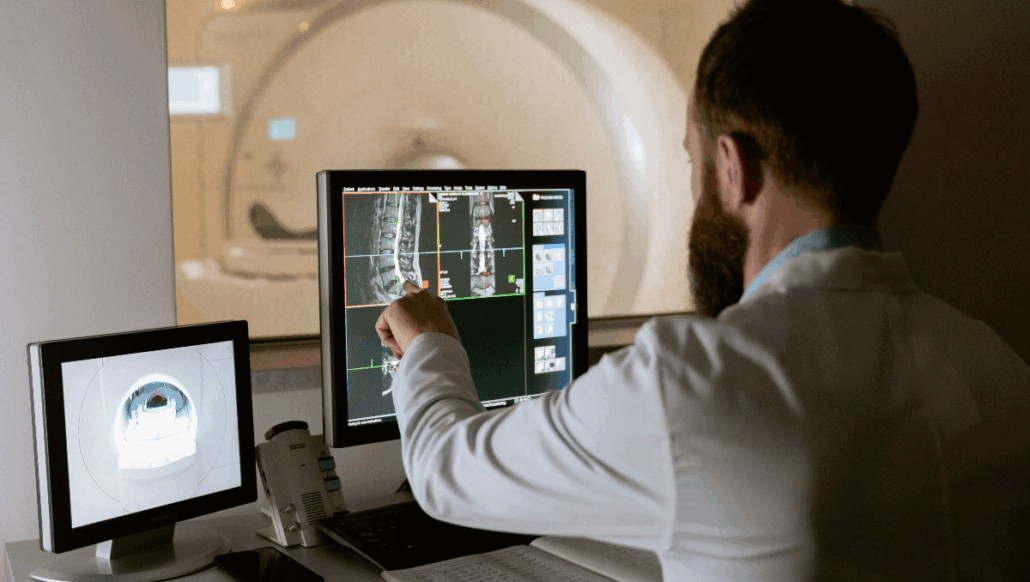
This is where pathway design becomes central. The diagnostic test itself is only one moment in a much longer sequence. If that moment is poorly timed, disconnected, or difficult to access, the entire chain of care becomes compromised. For example, a community-based MSK service that allows for direct-to-test imaging, triaged remotely and reported centrally, enables a patient with chronic back pain to be managed within a GP network-avoiding unnecessary referrals, prolonged discomfort, and delayed rehabilitation. But if that same patient must wait 12 weeks for a scan at a hospital two bus journeys away, the chance of effective, early intervention is greatly diminished.
Community Diagnostic Centres and Integrated Data Platforms
The 10-Year Plan seeks to address this not by adding more appointments, but by rethinking where and how those appointments occur. It sets out an expanded vision for Community Diagnostic Centres, integrated data platforms, and direct access for primary care. Underpinning all of this is a deeper principle: that pathways should reflect not organisational boundaries, but the lived experience of patients and the operational flow of population-level demand.
Delivering against that principle is complex. It requires shared planning between ICBs, Trusts, local authorities, and providers. It requires interoperable digital infrastructure that allows referral, imaging, reporting and results-sharing to happen seamlessly, regardless of site or setting. It requires a workforce model that can function across contexts. And it requires the consistent application of clinical governance, so that a scan conducted in a community setting is held to the same standards, audited in the same way, and managed with the same rigour as one delivered within an acute hospital.
But perhaps most importantly, it requires data-informed models of care that reflect the demographics, deprivation levels, and disease burden of local populations.
Consider the following:
- The Index of Multiple Deprivation (IMD) ranks areas based on income, education, employment, housing and health. The bottom quintile represents 20% of the population-but often accounts for over 40% of long-term condition burden in ICS datasets.
- In areas of high deprivation, attendance rates at hospital outpatient appointments fall by up to 15% when travel times exceed 30 minutes.
- Community diagnostics deployed in coastal towns and rural districts have demonstrated uptake increases of up to 60% in populations with previously low engagement.
- The majority of ICBs now identify diagnostic equity-not just capacity-as a central metric in their operational plans.
Medical Imaging Partnership’s Approach to System Transformation
Against this backdrop, the role of diagnostics providers becomes not simply to “offer services”, but to act as delivery partners within a population health framework. That means co-designing services around need. It means understanding how diagnostic access links to earlier cancer diagnosis, reduced referrals, improved patient experience, and shorter time to treatment. And it means working across modalities, specialties, and settings to create coherent, accessible pathways-not episodic transactions.
This shift is not only about capacity-it is about coherence. Systems cannot afford to operate diagnostics in isolation. Community imaging must feed back into primary care plans. Mobile MRI must be part of musculoskeletal transformation. Ultrasound services offered outside of hospital must still meet the clinical and digital standards expected within it.
It also requires cultural alignment. Providers must be willing to be held to account-not just for throughput, but for impact. That includes participating in joint audits, contributing to workforce development, and engaging in governance conversations at system level. The relationship must be collaborative, not contractual.
Building Resilience Through Community Diagnostics
In doing so, the system stands to gain more than operational relief. It gains resilience. It gains reach into communities that have long struggled to access early diagnostics. It gains the ability to plan around real demand, not just historic allocation. And it gains partners who understand that transformation is not a programme-it’s a posture.
For Medical Imaging Partnership, this posture is already embedded in how we think, design, and deliver. But more importantly, it is how we listen. To commissioners, to clinicians, to patients, and to the data that reveals where the system succeeds-and where it still falls short.
Diagnostics are the silent enablers of care. Done well, they reduce delay, uncertainty, and escalation. Done in the right place, at the right time, they change lives. The 10-Year Plan asks us to make that shift not incrementally, but systemically. The answer lies not just in equipment or estate-but in the design of pathways that reflect the realities of communities and the commitments of the system.
This is where population health becomes operational. Where the blueprint becomes the bedside. And where partnership becomes practice.
 OUR BLOG
 OUR BLOG